Tube Plugging & Heat Exchanger Maintenance System
BHEL Maitree Super Thermal Power Project, 2 × 660 MW, Bangladesh
A workshop-deployable system for controlled isolation and sealing of leaking tubes in condensers and heat exchangers, without full re-tubing during outages.
The Operational Problem
In large thermal power plants, tube leaks in condensers and heat exchangers are a frequent cause of forced outages. While individual leaks are small, their impact on plant availability is disproportionate.
Conventional methods rely heavily on manual tools leading to inconsistent quality, damaged tube-sheets, extended outage durations, and increased risk. For supercritical units, the tolerance for such variability is low.
Why Standard Methods Fall Short
Tube maintenance is often treated as a sequence of independent tasks. When cutting, pulling, and expansion use mismatched tools, cumulative errors are introduced.
- Ovalisation or scoring of tube-sheet ligaments
- Uncontrolled pulling forces distorting ageing tube-sheets
- Over-expansion or under-sealing during plugging
- Operator fatigue and safety risks during prolonged work
How the Solution Was Framed & Configured
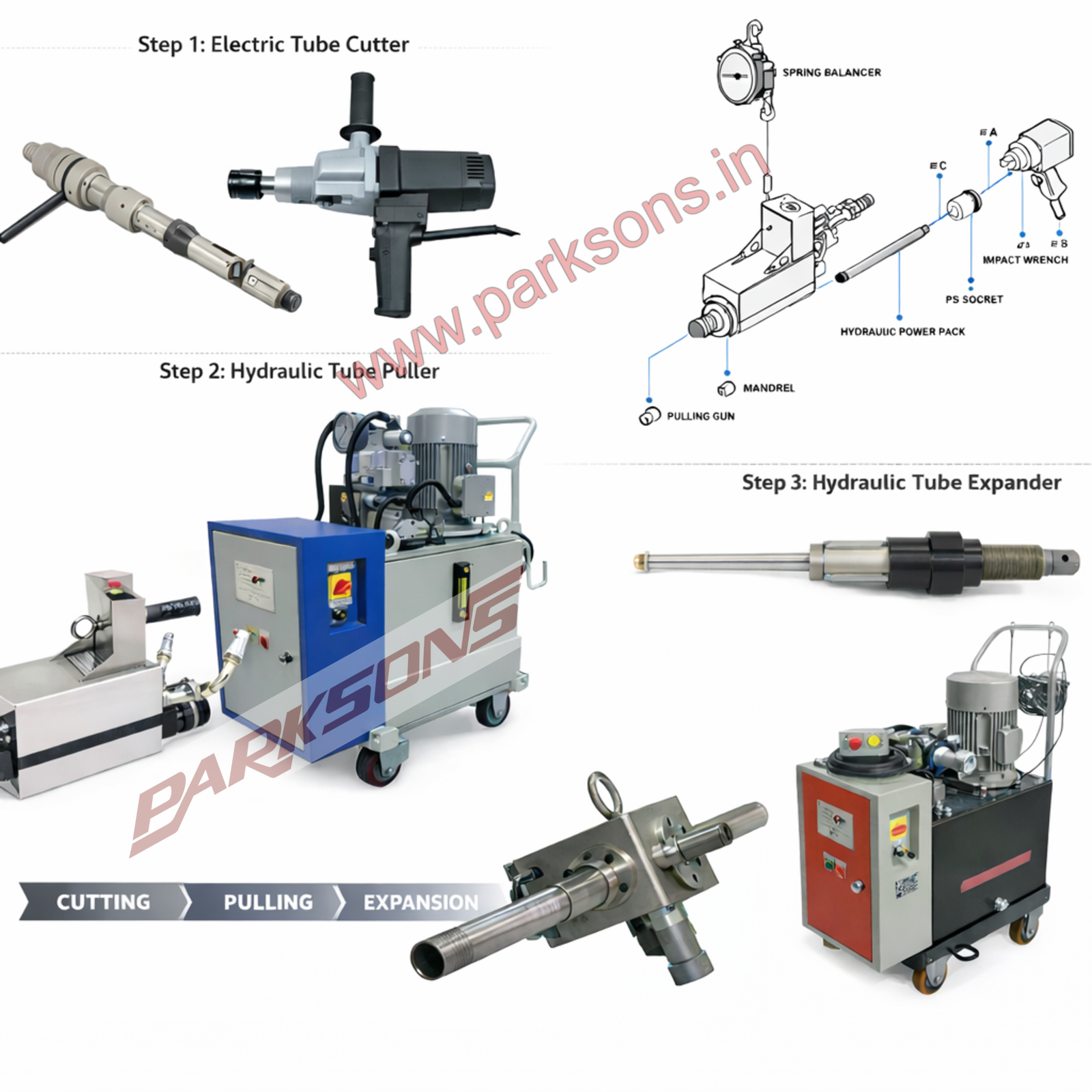
Parksons approached tube maintenance as a single, integrated operation. The system was framed around three non-negotiable principles: ID-referenced operations, controlled/repeatable forces, and scalability across tube sizes.
Internal Tube Cutting
- ID-based cutting to protect tube-sheet ligaments
- Tube ID range: ~30 mm to 50 mm
- Clean, concentric separation without ovalisation
Hydraulic Stub Pulling
- Axial pulling capacity up to ~45 tons
- Internal gripping mandrels for high-interference stubs
- Controlled extraction without tube-sheet distortion
Precision Expansion
- Hydraulic expansion with controlled torque/speed
- Tube classes covered: ~35 / 40 / 45 mm ID
- Zero-leakage sealing without overstressing
When This Makes Sense
When tube-sheet protection is critical, outage duration must be tightly controlled, multiple sizes are handled, and maintenance quality must be repeatable.
Discuss Your Plant's Tube Maintenance Challenge