Typical Applications
-
Machining of very long structural steel members (typically 8–30 metres) where operations are required only at one or both ends.
-
End machining of I-beams, H-beams, box sections, and fabricated girders used in infrastructure projects.
-
Drilling, milling, tapping, and facing operations on long welded fabrications that are impractical to reposition on conventional machines.
-
Fabrication shops supporting infrastructure, rail, shipbuilding, and heavy structural projects.
Machine Description
Machine Description
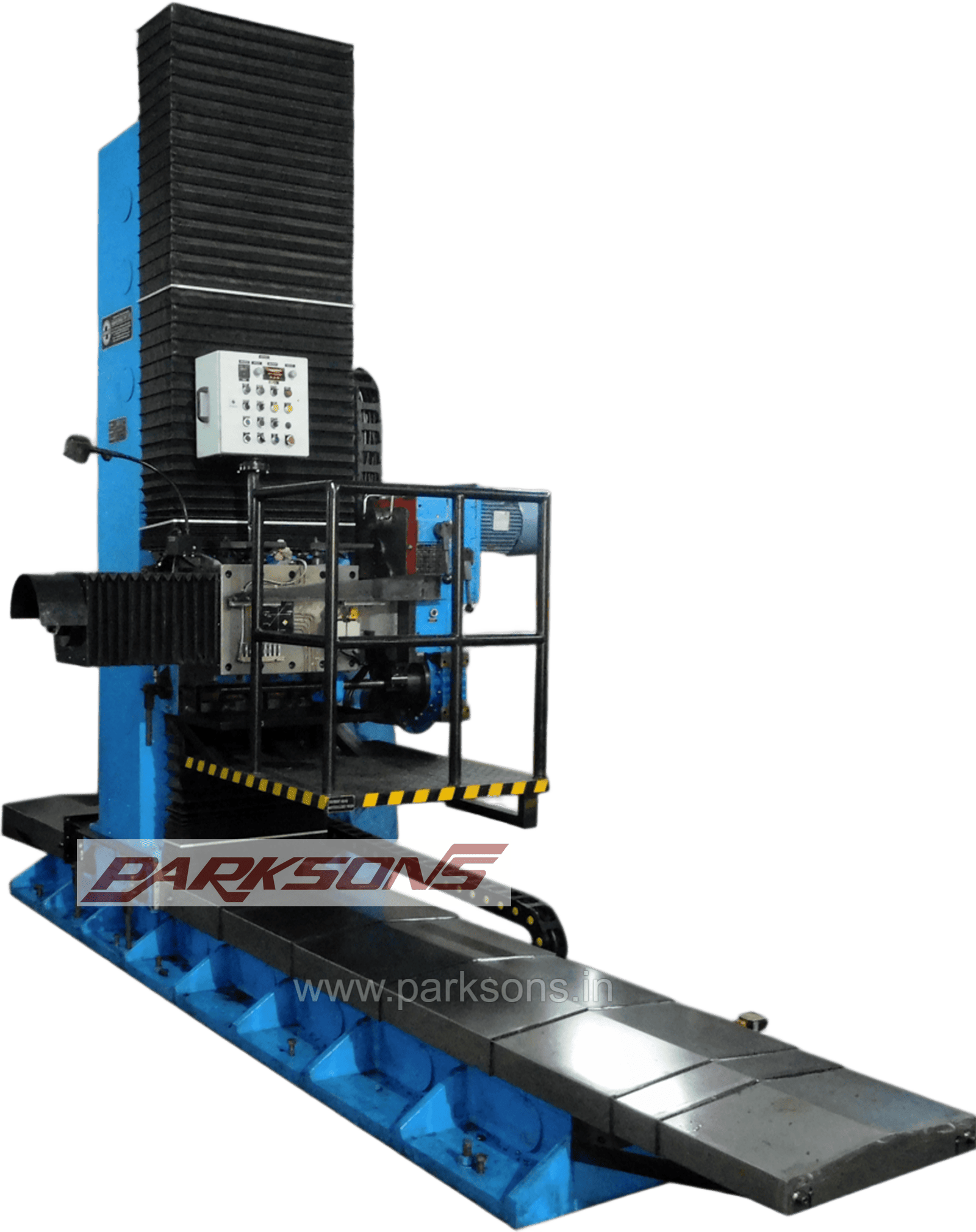
- • Travelling column milling machine designed for machining long workpieces while keeping the job stationary, in front of the machine.
- • Fixed machine bed with a moving vertical column, allowing the machining unit to travel along the length of the workpiece instead of moving high-mass material.
- • Rigid, ribbed cast iron structure (IS:210) providing stability during drilling, milling, and tapping at extended reaches.
- • Column-mounted spindle head with cross and vertical slides, enabling accurate positioning at the ends of long components.
- • Protected guideways with bellow / telescopic covers, suited to fabrication environments with dust, scale, and weld debris.
- • Well suited to applications where machining is localised, and full-length plano or gantry machining is unnecessary.
Typical Machining Capabilities
Typical Machining Capabilities
Axis Travels & Feeds
| Axis | Stroke Range | Feed Rate (stepless) | Rapid Traverse |
|---|---|---|---|
| X – Longitudinal (Column) | 1000 – 3000 mm | 40 – 1000 mm/min | ~1000 mm/min |
| Y – Vertical Slide | 300 – 1000 mm | 40 – 1000 mm/min | ~1000 mm/min |
| Z – Cross / Ram Slide | 300 – 500 mm | 40 – 1000 mm/min | ~1000 mm/min |
Spindle & Head
| Spindle Taper | ISO-40 / ISO-50 |
| Spindle Drive | VFD-controlled induction motor |
| Spindle Power | ~3.7 to 11 kW |
| Tool Clamping | Manual drawbar or automatic arbour clamping |
Configuration Notes
- 1. Travelling column machines are intended for localised machining on long components, not full-length surface milling.
- 2. Machine configuration depends on workpiece length, section size, and required operations, rather than standard models.
- 3. Drive systems, guideways, and spindle arrangements are selected based on load and duty cycle, not size alone.