Typical Applications
-
Designed for frequent setup changes in toolrooms and maintenance workshops where repeatability matters more than throughput.
-
General purpose lathe for turning of shafts, flanges, and bushes for cement, power, and steel plant workshops.
-
R&D applications in laboratory and defence engineering units.
-
Maintenance machining of couplings, pump shafts, and motor shafts in heavy industry plants.
-
Railway workshops for machining axles, pins, and repair parts.
Machine Description
Machine Description
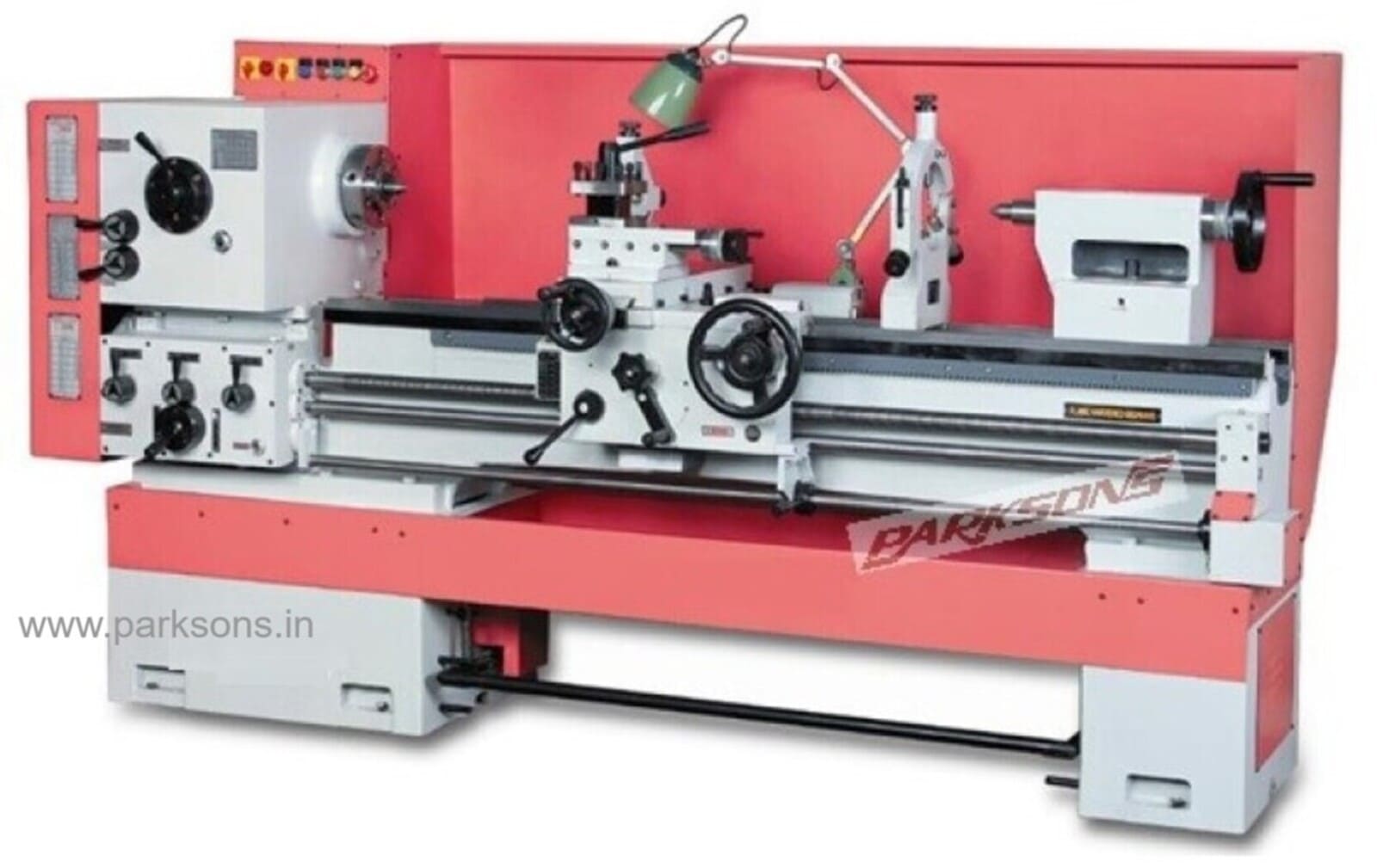
- • All-geared precision centre lathe for accurate turning and finishing of small-to-medium mechanical components.
- • High grade grey cast iron bed conforming to IS:210 with guideways hardened to 380-400 BHN, ground, and precision-scrapped to maintain alignment and dimensional repeatability over long service life.
- • Case-hardened and ground alloy steel spindle, supported on precision taper roller bearings for low run-out and stable concentricity.
- • Universal feed gearbox providing a wide range of feeds and threading options without frequent gear changes.
- • Balanced rigidity and speed range, suited for precision machining rather than heavy material removal.
Technical Specifications
Technical Specifications
| Capacity | TM-400 | TM-450 | GHL-300 |
|---|---|---|---|
| Center Height | 200 mm | 225 mm | 300 mm |
| Swing Over Bed | 400 mm | 450 mm | 600 mm |
| Swing Over Cross Slide | 250 mm | 280 mm | 370 mm |
| Distance Between Centers | 1000 mm / 1500 mm | 1250 mm / 1600 mm / 2000 mm | 2000 mm / 3000 mm / 4000 mm |
| Bed Width | 244 mm | 315 mm | 355 mm |
| Headstock | |||
| Spindle Nose / Bore | A2-6 / 55 mm | A2-6 / 55 mm | A2-8 / 80 mm |
| Spindle Speed Range | 71 to 1600 RPM | 40 to 2000 RPM | 27 to 700 RPM |
| Power | |||
| Main Motor | 3.7 kW | 5.5 kW | 5.5 kW / (O) 7.5 kW |
Accuracy
Geometric & Functional Accuracy as per IS: 1878 (Part-I)
- Work piece on Chuck (Turning) - Roundness of 0.01mm taper near headstock.
- Work piece between Centers (Facing) - Flatness of 0.02mm/ 300mm length in concave direction.
Accessories
Self-Centering Chuck
Independent Chuck
Foot Brake with Connected Shaft
Quick Change Tool Post
2-Axes Digital Read Out
Revolving Centre
Steady Rest
Follow Rest
Longitudinal Carriage Stop
Rear Splash Guard
Face Plate
C-40 Collet Chuck Set
Taper Turning Attachment
Rear Tool Post
Configuration Notes
Machines of similar size can behave very differently in real workshops. For heavy duty lathes, performance is influenced mainly by:
- 1. What components you are machining (size, weight, condition).
- 2. How often will you use the lathe (occasional work vs continuous duty).
- 3. How the job is supported in operation (steady rests, overhang, handling).