>>>>>
IN-HOUSE V/S OUTSOURCED CAPABILITY
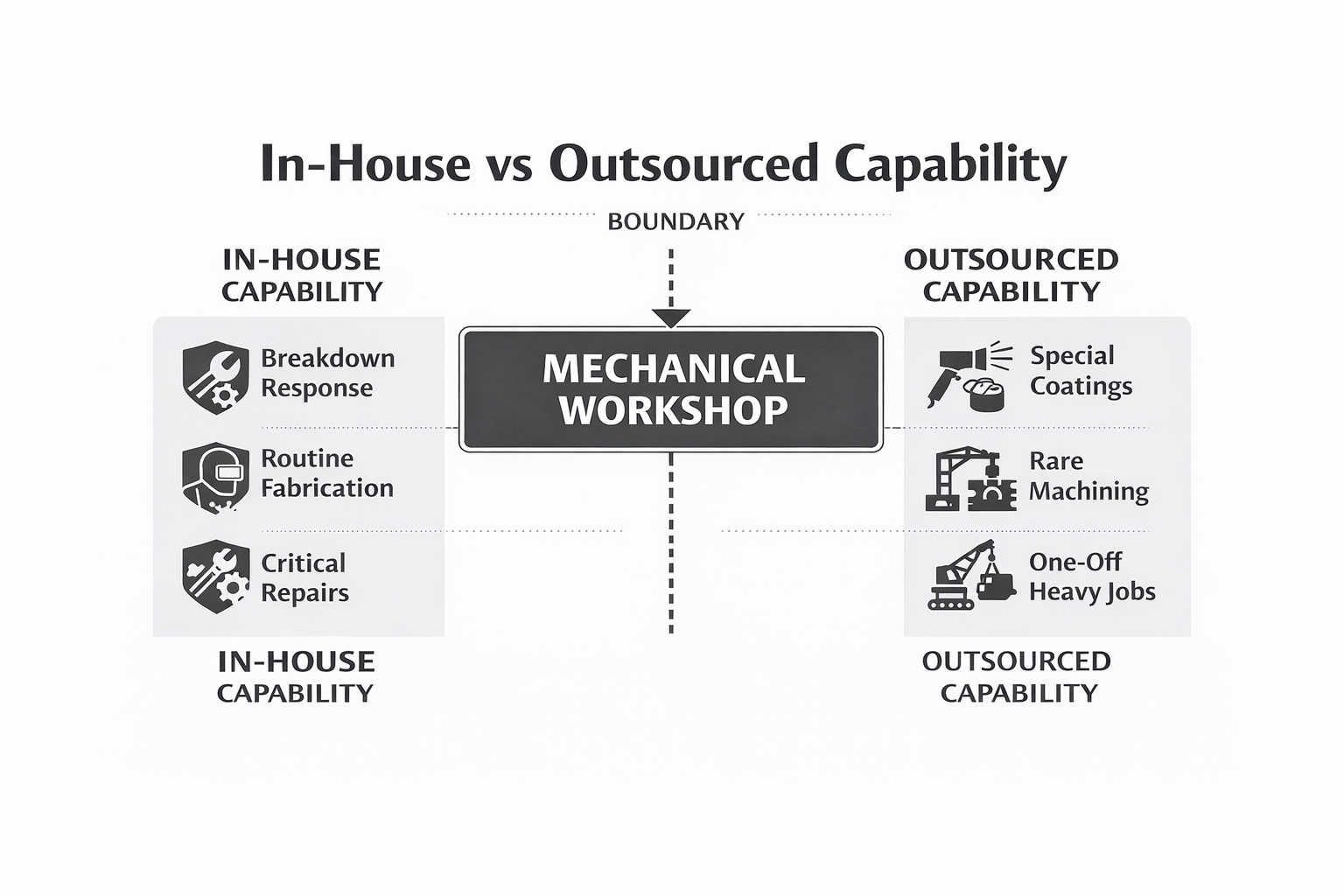
Deciding what the plant must be able to do for itself
A mechanical workshop is an internal engineering capability, not just a set of machines.
Its value depends on what the plant decides to do in-house versus outsourced - and how clearly that decision is defined upfront.
1
Define internal capability early
| Capability Type | Work to Keep In-House | Work to Outsource |
|---|---|---|
| Time Sensitivity | Time-critical to production or plant availability. | Non-urgent tasks with flexible timelines. |
| Technical Specificity | Work specific to unique plant equipment or designs. | Specialized or infrequent engineering requirements. |
| Frequency | Frequent tasks benefiting from staff familiarity. | High-complexity work that is inefficient to maintain internally. |
| Control Level | High: Response time and quality are critical. | Moderate: Clear boundaries avoid default dependency. |
2
State this clearly in the RFQ
Capability intent should be visible in the RFQ:
- What jobs the workshop is expected to handle
- What functions it is not intended to handle
- How machines are expected to support these objectives
This prevents mismatch between expectation, scope, and configuration.
3
Align machine configuration to capability goals
Once capability boundaries are defined, machine choices follow naturally.
- Robustness and duty cycle over peak ratings
- Setup time, access, and serviceability
- Suitability for repeated, real-world use
Machines should support the intended work, not just meet specifications.
Closing Note
01
Internal and external capabilities are complementary, not strictly competitive.
02
The key question is simple: What work should never depend on external availability?
03
Projects that answer this early give plants lasting control and flexibility.